5 ways audiobooks can help children develop a buzz for reading
Reading for pleasure plays a vital role in children’s literacy development, wellbeing and future learning outcomes. Yet research continues to show that fewer children are choosing to read in their free time, making it increasingly important to find engaging ways to connect young readers with books.
One increasingly popular option is audiobooks. In 2026, the National Literacy Trust found that 47.3% of children and young people said they listened to audiobooks or podcasts, highlighting the growing role of audio in how children engage with stories.
While audiobooks are not a replacement for reading, they can complement traditional books and encourage reading for pleasure. Among children and young people who listen to audiobooks, over half (50.3%) said listening feels like reading, while more than a third (36.6%) said listening had made them interested in reading. Nearly a third (30.1%) also reported that they sometimes read along while listening.
Audiobooks were also associated with imagination, immersion and other positive reading experiences, showing how they can help towards children developing a lasting love of stories and books.
Here are five ways audiobooks can help children develop a genuine love of reading.
1. Introduce new vocabulary and model fluent reading
Audiobooks model fluent reading and allow children to access stories they may not be able to read independently. Through audiobooks, children gain exposure to engaging stories and new vocabulary that they may not have been exposed to if they struggle with traditional texts. Hearing complex words can also help children to recognise words in texts as they increase and improve their vocabulary.
Listening to audiobooks also help children to hear the letter patterns and understand how complex words are pronounced. This can help them to improve their reading fluency, which includes the ability to read with proper speed, accuracy and expression.
For children who find reading challenging, audiobooks give children access to stories that may be beyond their current reading level, exposing them to a wider range of vocabulary, language patterns and ideas.

2. Improve engagement and stimulate imagination
While audiobooks can lack visual or tactile engagement, listening to stories can help stimulate imagination and improve focus in children. They allow children to practice visualising what’s happening in a story, encouraging them to imagine the settings and characters.
Families and teachers can support this by asking children questions about the audiobook, like “how do you picture the characters?” or “if you were walking through the setting, what do you see, hear, smell or even taste?”. These questions encourage children to draw their own opinions about the text and prompt them to get creative with their answers.
3. Support wellbeing
Storytelling has long been associated with comfort, relaxation and emotional connection. For many children, listening to an audiobook can provide a calm and enjoyable break from busy daily routines.
Audiobooks are often used during quiet time, before bed or while travelling, helping children build positive reading experiences that fit naturally into family life.
Listening to stories can also offer children a safe space to explore emotions, work through challenges and temporarily escape everyday worries.
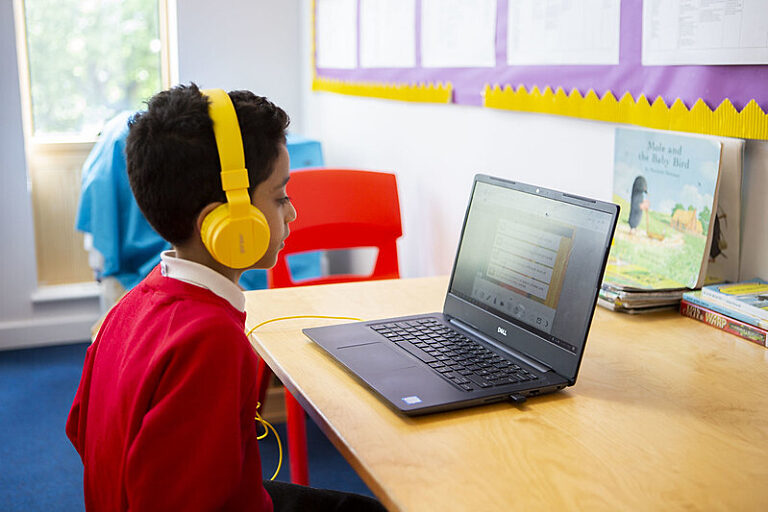
4. Build empathy and emotional understanding
Like traditional books, audiobooks are a great way for children to engage with diverse characters and situations, which can help them to develop empathy and emotional understanding.
Audiobooks can also make complex themes more accessible, allowing children to explore important topics in an engaging and age-appropriate way.
5. Widen access to books and inspire a love for reading
One of the biggest benefits of audiobooks is accessibility. Children can enjoy stories wherever they are, whether at home, travelling or participating in other activities.
For reluctant readers, children with additional needs or those who lack confidence with traditional reading, audiobooks can offer an alternative route into stories and books.
Digital audiobook platforms also make it easier for children to explore different genres, authors and series. This freedom to discover new interests helps children develop their reader identity and can inspire them to seek out more books in formats that work for them.
Helping more children discover the joy of reading
Audiobooks can be a powerful tool for building a reading culture, helping children access stories, develop literacy skills and enjoy reading in ways that work for them.
At Bookmark, we know that every child deserves the chance to discover a love of reading. That’s why audiobooks form part of our Literacy Partner Programme, helping schools create inclusive reading environments and support children who may otherwise disengage from books.
Literacy Partner Programme
Bookmark’s Literacy Partner Programmes offers primary schools grants of up to £10,000 that support the school in developing a whole school reading culture.
Read moreNational Literacy Trust. "Children and young people's audio listening in 2026": https://literacytrust.org.uk/research-services/research-reports/children-and-young-peoples-audio-listening-in-2026/
